

In my work as Director of Scheduling for Skanska Civil U.S. on the West Coast, I see the importance of getting it right when it comes to creating and adjusting schedules with complex specifications, changing environments, multiple stakeholders, and authorities having jurisdiction (AHJs).
Artificial intelligence and generative scheduling have become increasingly prevalent in the way projects operate. Civil infrastructure has unique scheduling needs due to a lot of factors including size, scope, and location. As a scheduler, I am genuinely curious about how these growing technologies will change how we build schedules and serve clients.
As it stands, my view on the topic of AI in scheduling is broader than a focus on generative scheduling. I see the space breaking down into three distinct categories. While they are often lumped together, they are different in maturity and value.
Analytical
This includes AI being applied to an existing schedule to run key performance indicators (KPIs), answer natural-language questions, and flag health issues or logic problems. This is the most mature category and the lowest-risk entry point.
Generative or Agentic Schedule Development
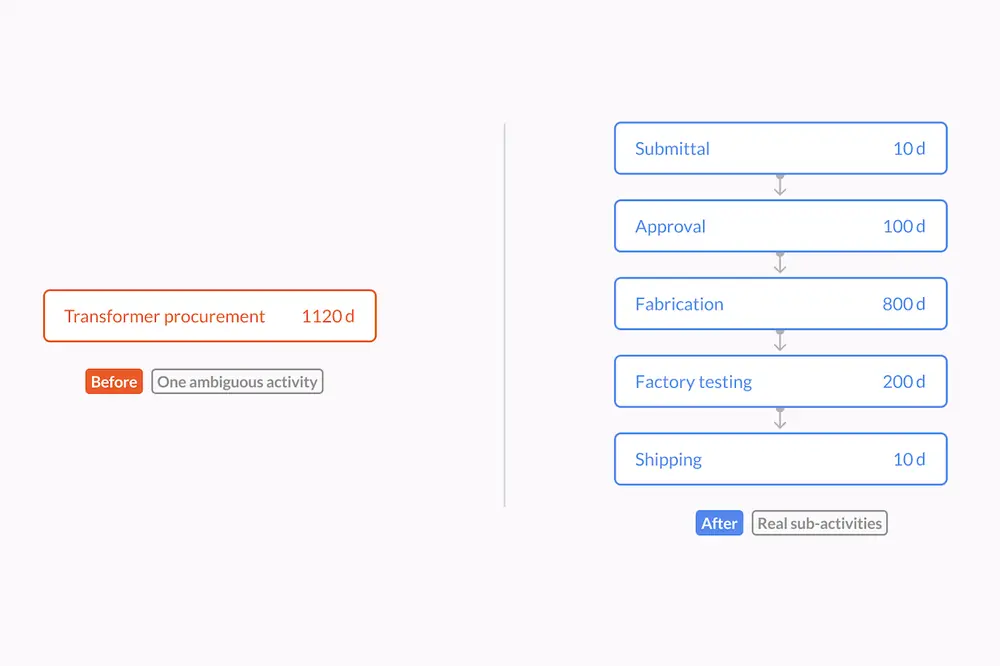
AI can assist in building a schedule from source documents like drawings, specs, and contract requirements. This is guided by preset criteria or guardrails, often through a "wizard" workflow that breaks project documents down into schedulable activities and logic based on certain presets which are modeled from a global and/or project level.

| Your local Superior dealer |
|---|
| Westate Machinery Co |
In an earlier stage, these tools accelerate drafting, but constructability sequencing still needs the judgment of experienced schedulers. It requires steering the AI agent to advance the schedule from a draft to something more realistic. Over time, the AI agent gets better as it learns from that input.
“What-If” Scenario Analysis
AI can use computing power to generate and evaluate large numbers of schedule scenarios for proactive risk identification and planning. This can surface potential issues collaboratively, before they become problems. It can be a powerful tool, but it is only as good as the underlying logic it starts from.
This is some of the most exciting technology I’ve seen in 20 years in the field. It is only possible with the collaboration and expanding networks of the individual people exploring what this technology can do.
I am a member of several organizations dedicated to schedulers in construction. In these environments, we share our experiences, our success, and our challenges. Just talking to each other makes widespread use of the AI scheduling tools possible.

| Your local Metso Minerals Industries Inc dealer |
|---|
| PacWest Machinery |
| Westate Machinery Co |
Currently, we are having conversations and working closely with platform developers as they develop their own AI scheduling tool. We bring our field experience to help shape product direction. This input is invaluable in this space right now. Scheduling has a large role in a project’s success, and collaborative relationships between contractors and developers create an end product that is much more innovative.
Internally, Skanska in U.K. operations have used generative scheduling on a larger scale. One of Skanska’s greatest benefits is that we have those networks to communicate about similarities and differences in implementing these new technologies. While we continue to build a system to best integrate these technologies across civil operations, we have leveraged our knowledge and experience in the civil construction industry to influence the development of AI scheduling tools.
The construction industry is transforming how we approach scheduling projects. I have worked with companies that are leading efforts on agentic and generative scheduling that use AI not only to assist schedulers but to generate and optimize schedules in new, revolutionary ways.
Skanska has been shaping the generative AI space by bringing our experience to make sure these tools work with what the industry needs. We have entered partnerships in the early stages of development to ensure the models have a level of control that makes generative schedules usable and successful on real, complex construction projects.

| Your local Trimble Construction Division dealer |
|---|
| SITECH Northwest |
I see that generative scheduling is not only the future, but the present. Being an engaged partner, Skanska has worked with developers to build their platform around the realities of construction. The guardrail system allows users to encode their complex project requirements directly into the platform, so that any AI-generated schedule is more aligned to work within those boundaries from the start.
When asked about my posture with regard to what we are doing at Skanska, I say, “engaged and uncommitted.” Skanska is a big company and technology improves quickly. We are engaged in new platforms and tools and involved in shaping how they interact with real project needs. We are currently testing our first generative scheduling tool but are uncommitted to one specific platform for now. For a company of our size, we are in a position to stay competitive and not be caught flat-footed.
We are actively testing and learning on real projects. We are uploading plans, specifications, utilities, and calendar constraints to accelerate drafting for our experienced team to review, with calendars, work breakdown structure (WBS), activities, and logic ties as a starting point. The goal is not to hand the schedule over to AI to develop it for us, but to give our schedulers a better starting point so their judgment goes further.
Clients are looking at AI as a potential differentiator among bidders. Two-step procurement models are becoming more common in the civil construction industry. That gives contractors more of an opportunity to showcase what they bring to the table beyond price.

| Your local Gomaco dealer |
|---|
| Gomaco -Contact For a Dealer Near You |
On our projects, schedules that are more defined, organized, and complete — with proper scope gap checks — help our project teams better communicate with each other, subcontractors, stakeholders, and customers. I see a future where this technology helps prevent the kind of misalignments that too often become disputes.
As a leader, it's my job to make sure my team is ready for the evolution of AI in scheduling. We are starting now to build the workflows and training that let schedulers use these tools effectively without losing the judgment that makes a critical path method (CPM) schedule usable. It is not about replacing schedulers but about freeing them up for higher-value work.
The honest risks are worth addressing. False confidence from "optimized" schedules built on bad underlying logic or overreliance on outputs nobody on the team can understand or defend are a concern.
But I'd also frame this as a reason to engage now rather than wait. This technology is improving quickly, and being part of the feedback loop with developers is how we help it mature faster and benefit sooner.
| Your local Superior dealer |
|---|
| Westate Machinery Co |
At the end of the day, a schedule is a vision of how we will build the project — to an owner, to a community, and to the people building the project. AI does not change that vision. It gives us better tools to realize it. That is what building for a better society looks like in the scheduling room.